
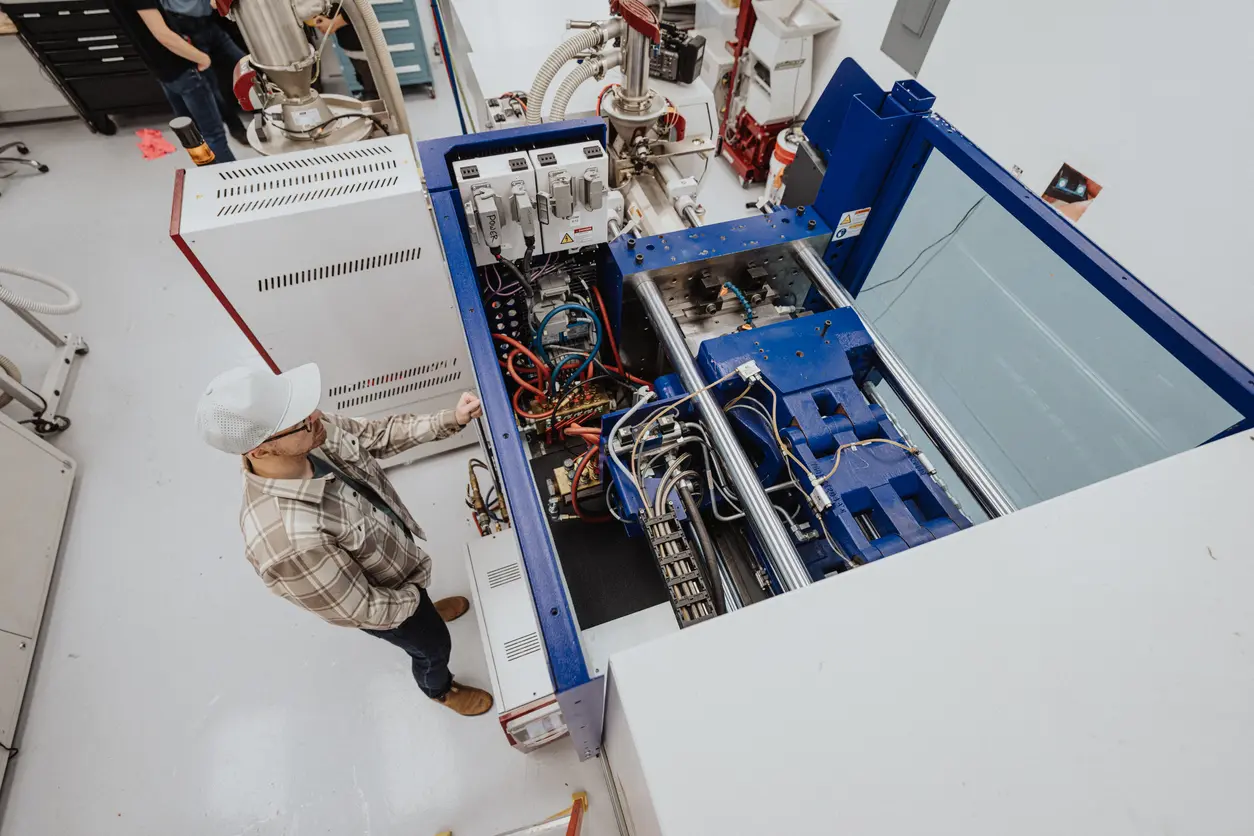
Injection molding is one of the many different types of plastic part manufacturing methods. It appeals to OEMs and supplier programs searching for repeatable manufacturing with cost-effective practices at high volumes.
So, when should decision makers at OEMs or supplier programs consider injection molding over other choices? Agape Plastics highlights the key points to weigh while comparing injection molding directly against other plastic fabrication methods.
When Injection Molding Makes Sense
Plastic part manufacturing where injection molding is the production method of choice hinges on four items:
- Production volume justifies tooling costs
- Locked-in design
- Repeatable, detailed parts are the expected outcome
- Properly accommodate for tooling lead time
If these four items are all on the table, injection molding should be the top option for your team. Let’s dive a little deeper into each for more explanation.
Production Volume
Injection molding’s most expensive aspect takes place at the very beginning. Designing, manufacturing, and qualifying the mold, along with other tooling considerations, do much of the heavy lifting on costs. However, when tooling is finalized, injection molding supports repeatable production with a relatively low per-part-cost. This is especially true when plastic part manufacturing programs feature high component volumes often starting at 10,000 parts in a production cycle.
Design
Injection molding best supports designs that feature consistent wall stock, no thick to thin sections, and more. Complex designs are one of the true differentiators for injection molding compared to other plastic part manufacturing operations.
During pre-manufacturing operations, if design changes need to be implemented, it’s critical to have them made before the hard tooling is created. Manufacturers like Agape Plastics offer design feasibility reviews to gauge how strong an initial design is.
Repeatable Manufacturing
Parts that need to be identical from one batch to another with minimal differences benefit from injection molding. Through proper process control and mold maintenance, injection molding is a highly repeatable form of plastic part manufacturing. Not only are critical features such as the incorporation of ribs and bosses repeatable, but surface finish and dimensional consistency also are achievable and repeatable.
Tooling Lead Times
As far as lead times go for an injection molding program, they vary from part to part, and with consistent communication from your supplier, you’ll find that tools and molds are created for multiple cycles.
Comparing Other Plastic Part Manufacturing Services
While injection molding is a strong manufacturing option, it’s important to compare it against other, similar methods.
| Alternative | When to Give Preference | When Injection Molding is Favorable |
|---|---|---|
| 3D printing | Prototyping, frequent design changes, low-volume production | Established design and a need for repeatable manufacturing. Injection molding will often utilize 3D printing for its prototyping operations and use the printed part to create a more durable finished component |
| CNC machining | Small production volumes, design flexibility, demanding precision needs | Require identical parts and cost-effective manufacturing. Injection molding |
| Thermoforming | Considered for more simple designs | Detailed components that feature integrated items such as ribs, bosses, or clips |
| Blow molding | Hollow, thin-walled products | Detailed components |
Final Considerations Before Committing
If internal conversations are pointing toward injection molding, there are a few final items to consider before deciding. Assuming your team has found the right manufacturer, part of the initial dialogue should include handing over tentative part drawings, material considerations, projected production volumes, and logistic requirements. This allows for the manufacturer to properly establish the foundation of the program. From there, ask for a review of moldability risks such as wall thickness, draft, parting lines, and any shrinkage.
Other items to consider include conversations on tooling ownership, maintenance, expected tool life, and sampling or prototyping.
Partner with Agape Plastics for Your Plastic Part Manufacturing with Our Custom Injection Molding Operations
Agape Plastics, located in Grand Rapids, Michigan, has served as the custom injection molding manufacturer that OEMs, supplier programs, and other customer sources have trusted for over 50 years.
Plastic part manufacturing through injection molding at Agape begin with thorough design for manufacturability analysis and tooling operations. During the pre-manufacturing phase, we work collaboratively to make sure all aspects of the production program, from material selection to any pre-assembly features, are correctly acknowledged.
Our injection molding operations are backed by 46 machines with skilled operators ensuring parts are being created according to spec. Quality management is just as important as the process. At Agape, our manufacturing capabilities are backed by our robust quality management systems which have been continuously IATF 16949:2016 certified for years. In order to keep quality at the center point of every project, we have a dedicated program manager, customer quality engineer, launch support with samples, tuning, part print development, and 24-hour customer support for on-site maintenance.
Contact our team today when injection molding is your preferred method for your plastic part manufacturing program.